
Member Registration Information
Member Registration is open!
Attendance is FREE for MEEC Members!
Sponsors
Showcase and Participation Vendors
Adobe
Advanced Computer Concepts
Alliance InfoSystems, LLC
Alliance Technology Group, LLC
Applied Technology Services
Audio-Video Group, LLC Audio
Avaap
Cambridge Computer Services
CAS Severn, Inc
Cenero
Copper River Family of Companies
Creative Information Technology Inc.
CW Technologies
Dell Technologies
Deloitte Higher Education
Design and Integration
Dexian
Echo360
En-Net Services
Extron
Ferrilli
Global Alliant, Inc
Google for Education
HTC Global Services, Inc
Infojini, Inc.
IP DataSystems, Inc
JANUS Associates
Lee Hartman and Sons
Lenovo
Microsoft
MidPoint Technology Group
Net-AV
Networking for Future, Inc
NGEN LLC
NWN Carousel
Panopto
Presidio
Sandy Audio Visual LLC
SHI International Corp.
Sierra-Cedar
Sun Management
System Source
UVS Infotech
Vision Technologies
vTech Solutions, Inc.
Xerox IT Solutions
General Schedule
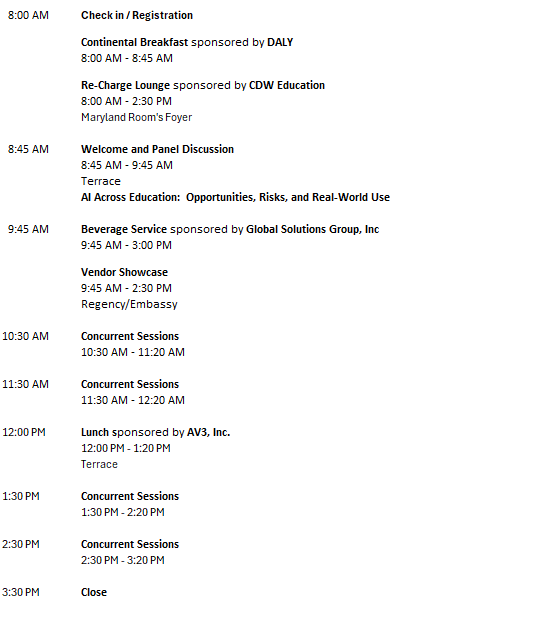
2026 Conference Sessions
| Room / Time | Maryland A/B | Maryland C/D | Camelia | Wayne |
|---|---|---|---|---|
| 10:30am - 11:20am | Preparing for ADA Title II with Anthology Ally: A Campus-Wide Accessibility Strategy | Securing the Future of Education: Updating the Cybersecurity | Beyond the Bot: Strategic AI Adoption in Higher Education IT | Top 10 AV Trends in Education for 2026: Empowering K–12 and Higher Ed Through Smarter Technology |
| 11:30am - 12:20pm | Agentic AI Based Procurement Document Creation | Making Sense of AI: A Decision Framework for Education and Public Sector Organizations | The Educator’s Co-Pilot: Everyday Productivity Wins in M365 Copilot Chat | Smarter Disaster Recovery: Leveraging AI for Operational Continuity |
| 1:30pm - 2:20pm | Making iPaaS and AI Work Effectively Together | From Firewall to Fabric: Building a Unified Security Architecture for K-12 and Higher Ed Powered by AI | Building Trust in Data: Actionable Approaches to Sustainable Governance | UVS Intelligent Campus Experience Suit |
| 2:30pm - 3:20pm | Empowering the Digital Campus: Enhancing Student Support with AI, Automation and Analytics | Gemini for Education: An Educator’s Toolkit for the Latest AI Features | Driving Business Value Through Organizational Change Management | Securing Education Environments with Microsoft Security and Intune |
Making iPaaS and AI Work Effectively Together
Read more Read less
Discover how integration and automation can transform IT operations! In this session, we’ll explore how The Community College of Baltimore County leverages TeamDynamix iPaaS platform in combination with Microsoft Copilot to streamline workflows and accelerate productivity.
You’ll learn how these tools work together to:
- Automate routine tasks and reduce manual effort
- Rapidly create procedures and knowledge base articles
- Improve service delivery and operational efficiency
We’ll go beyond theory with live demonstrations of real-world workflows developed by our team—showing practical examples of how iPaaS and AI can complement each other to deliver measurable results.
Beyond the Bot: Strategic AI Adoption in Higher Education IT
Read more Read less
Artificial intelligence in higher education is evolving rapidly—from basic chat interfaces to sophisticated, personified agents and domain-specific models. In this session, Craig Klimczak, CIO at the Community College of Baltimore County (CCBC), shares a year of hands-on experimentation and deployment of AI technologies across the institution. Learn how CCBC is leveraging tools like Microsoft Copilot Chat and Element451’s AI-first CRM to enhance operations and engagement.
This presentation will go beyond surface-level AI use cases to explore:
- The emergence of personalized AI agents that simulate human interaction
- Specialized models tailored for higher ed workflows
- Pricing models and cost considerations for enterprise AI adoption
- Policy development, governance, and ethical implications
- The critical role of training and change management in successful implementation
Designed for CIOs, technologists, and IT leaders, this session offers strategic insights into what’s working, what’s next, and how to prepare your institution for the AI-powered future.
Preparing for ADA Title II with Anthology Ally: A Campus-Wide Accessibility Strategy
Read more Read less
Public higher education institutions must now align digital content and learning technologies with the updated ADA Title II digital accessibility regulations, which require web content, mobile apps, course materials, and other digital services to meet accessibility standards such as WCAG 2.1 Level AA. These regulatory expectations extend to all state and local government entities, including public colleges and universities, and create both compliance challenges and opportunities for meaningful inclusion.
At Coppin State University, these requirements prompted a deliberate shift from reactive remediation to a coordinated, campus-wide accessibility strategy. In this session, we will share how Coppin has operationalized ADA Title II digital accessibility compliance by leveraging Anthology Ally as a foundational tool within a broader institutional framework. Participants will learn how Ally is integrated into Coppin’s learning management system to identify accessibility gaps, deliver actionable feedback to instructors, generate alternative content formats, and produce institution-level reporting that supports data-informed planning and accountability.
We will also discuss how Coppin structured training and support to equip faculty, staff, and administrators with the knowledge and workflows needed to improve accessibility outcomes. Practical insights will include real examples of unit-level planning, awareness campaigns, and compliance checkpoints. More importantly, the session will explore how Anthology Ally is embedded into a broader strategy that emphasizes education, policy alignment, and continuous improvement—moving beyond tool adoption toward sustainable cultural change.
Attendees will leave with concrete lessons learned from Coppin’s experience, including tools, resources, and implementation strategies that equip participants with an implementation mindset for using Anthology Ally not only to meet legal obligations, but also to advance equity and access for all learners.
Smarter Disaster Recovery: Leveraging AI for Operational Continuity
Read more Read less
Disaster recovery has always been critical, but when was the last time you evaluated your strategy? In this session, we’ll revisit why DR planning remains essential for K–12 and Higher Education and why it should never be overlooked. Hear firsthand from Rob Carpenter, Network Administrator / I.T. Manager at Dorchester County Public Schools, as he shares real-world lessons learned using Veeam and partnering with Data Networks. Then, explore how AI-driven innovations and Veeam’s future roadmap are transforming resilience with predictive threat detection, automated clean restores, and intelligent compliance. Walk away with practical insights to keep your institution prepared for whatever comes next.
UVS Intelligent Campus Experience Suite
Read more Read less
Higher education institutions face growing pressure to deliver seamless, accessible services while managing limited resources and rising demand. This session explores how AI-driven automation and intelligent campus navigation can work together to enhance the campus experience while streamlining operations across student services and IT.
Attendees will learn how AI can automate high-volume Student Information Center and helpdesk interactions, such as password resets and common inquiries, providing 24/7 support and freeing staff to focus on complex, high-impact needs. The session will also highlight how intelligent campus mapping and wayfinding tools improve accessibility, engagement, and resource utilization through real-time navigation, event awareness, and ADA-accessible routing.
This session will share practical use cases and key considerations for implementing scalable, secure solutions that support digital transformation, improve service delivery, and elevate the campus experience.
From Firewall to Fabric: Building a Unified Security Architecture for K-12 and Higher Ed—Powered by AI
Read more Read less
K-12 districts and higher education institutions are facing the same reality: more users, more devices, more cloud apps, and more threats—often with limited staff and budgets. At the same time, AI is reshaping both sides of cybersecurity: threat actors are using AI to accelerate phishing, malware development, and social engineering, while defenders are using AI to improve detection, automate response, and reduce operational burden.
This session will explore how education institutions can modernize cybersecurity by moving from disconnected point products to an integrated, unified security architecture that improves visibility, speeds response, and reduces complexity. Presented by ePlus and Fortinet, the discussion will focus on how AI-enabled security operations can help teams prioritize risk, detect anomalies earlier, and respond faster—especially when resources are limited.
Attendees will learn practical strategies to align network security, endpoint protection, identity controls, and cloud security into a cohesive approach, with a focus on how AI and automation can strengthen segmentation, reduce ransomware impact, streamline policy enforcement, and produce actionable reporting for leadership. The session will include lessons learned and a recommended roadmap that IT teams can tailor to their environment.
Securing Education Environments with Microsoft Security and Intune
Read more Read less
Discover how Microsoft’s comprehensive security ecosystem—including solutions like Microsoft Purview, Identity and Access Management (IAM), Microsoft Defender, and Sentinel—helps protect K–12 and higher education environments. While we’ll provide a high-level overview of these tools, the majority of this session will focus on Microsoft Intune and its role in simplifying device management and strengthening endpoint security.
We’ll explore practical strategies for:
- Hardening endpoints and managing diverse devices, including Windows, Mac, iPad, Android, and Chromebooks
- Leveraging Intune’s integration with Azure AD for identity protection
- Maximizing existing Microsoft licensing to eliminate redundant point solutions and improve security posture without additional costs
Data Networks uses a simple complimentary assessment to uncover opportunities to “find budget” and reinvest in security enhancements
This session emphasizes “leveraging what you own” to achieve robust security and cost efficiency—helping education institutions do more with less while strengthening protection across their environments.
Gemini for Education: An Educator’s Toolkit for the Latest AI Features
Read more Read less
Ready to start leveraging the newest, most impactful purpose-built AI tools from Google at no-cost? This isn’t a lecture…it’s an interactive, action-oriented session designed to give you instant, practical takeaways you can use in your classroom today. We’ll show you exactly how to automate common tasks, personalize learning for students, and generate stunning visuals, all without ever reaching for your wallet.
Agentic AI based Procurement Document Creation
Read more Read less
Higher education procurement teams face increasing pressure to deliver compliant, high-quality solicitations while managing complex requirements and limited resources. This session introduces an Agentic AI-enabled solution that supports procurement staff across the full procurement lifecycle, from solicitation creation through contract award.
Attendees will learn how the solution streamlines RFIs, RFPs, RFQs, vendor evaluations, and award documentation using organization-approved templates and agency-specific knowledge. Using agentic AI, users can generate and refine document sections with plain-English inputs, no prompt engineering required, while maintaining consistency and compliance. Drafts can be saved, reviewed, and resumed at any stage.
The session will also highlight built-in security and governance, including role-based access controls, encryption of data at rest and in transit, and full administrative oversight.
Empowering the Digital Campus: Enhancing Student Support with AI, Automation and Analytics
Read more Read less
As educational institutions face increasing pressure to provide 24/7 support with limited staff, the role of AI and intelligent automation has become vital. This session explores how the latest advancements in “agents” and automated workflows can handle routine inquiries, allowing staff to focus on high-touch student interactions. We will demonstrate how a connected ecosystem—using data from across the institution—can proactively identify students who need support and provide personalized resources at scale. We will look at practical applications for AI in education that improve the student experience without losing the “human” element. This session is designed for organizations looking to understand how the next generation of Salesforce and Tableau tools can drive efficiency and deepen student engagement.
Driving Business Value Through Organizational Change Management
Read more Read less
Change is inevitable—but successful change requires more than a plan; it demands people-focused strategies. This session explores the principles of Organizational Change Management (OCM) and how they enable smooth transitions during technology implementations, process improvements, and cultural shifts. Attendees will learn practical frameworks for engaging stakeholders, reducing resistance, and fostering adoption. Through real-world examples and actionable insights, we’ll show how OCM aligns people, processes, and technology to deliver measurable business outcomes. Whether you’re leading a project or influencing change, this session equips you with tools to turn disruption into opportunity.
Top 10 AV Trends in Education for 2026: Empowering K–12 and Higher Ed Through Smarter Technology
Read more Read less
The audiovisual landscape in education is evolving rapidly—fueled by advancements in software-defined infrastructure, AI-powered collaboration tools, and growing demands for inclusive, hybrid-ready environments. For Maryland’s K–12 and higher education institutions, staying ahead of these trends is essential for improving teaching, learning, and operational efficiency.
This session, presented by Sandy Audio Visual (SAV)—a Maryland-based AV integrator with decades of expertise in education AV—delivers a forward-looking analysis of the Top 10 AV Trends shaping classrooms, lecture halls, and campuses in 2026. With practical examples, demonstrations, and implementation tips tailored to MEEC members, attendees will leave empowered to make smart, strategic AV decisions that align with evolving pedagogical and technical demands.
Building Trust in Data: Actionable Approaches to Sustainable Governance
Read more Read less
Data has become one of the most consequential assets for education and government institutions, creating both opportunity and complexity. However, many data governance efforts struggle to gain traction or deliver lasting value. Too often, they are framed primarily as a technology initiative, driven by tool selection rather than organizational need. Effective data governance is essential for enabling trusted analytics, accelerating technology transformation, and supporting institutional decision-making, not just meeting compliance requirements. This session will share practical strategies for launching and maturing data governance programs, grounded in real university and state government experience. Participants will learn how focused, achievable steps tied to business priorities can build confidence in data and create lasting impact. Attendees will leave with common challenges, lessons learned, and actionable recommendations adaptable to any stage of their governance journey.
Securing the Future of Education: Updating the Cybersecurity Playbook
Read more Read less
Education institutions face increasing cyber threats while balancing access, innovation, and compliance. This presentation introduces the Microsoft Education Security Toolkit, a unified, AI‑powered approach built on Zero Trust principles to protect students, educators, research, and data. We’ll explore how integrated security across identity, devices, data, and AI can simplify operations, strengthen resilience, and support secure digital learning at scale. Real‑world examples from K–12 and higher education illustrate how security can evolve from a defensive necessity into a strategic enabler
The Educator’s Co-Pilot: Everyday Productivity Wins in M365 Copilot Chat
Read more Read less
Show practical, daily wins that reduce burnout and administrative overhead.